Multiple Guests
Inspired Generosity Awards: Meet the $10,000 Winners
Our listeners sent more than 500 nominations for great organizations helping others. Five will receive a $10,000 grant. Here are their stories.
It's both heartening and inspiring to know there
are so many people doing great things for others.
Too often, these organizations go unrecognized — except by the people they serve.
That's why, for the past several years, we've
turned to listeners like you and asked:
Who would you like to celebrate for the Crazy
Good Turns they do?
This is the third year in which we've ended our
season by providing $10,000 grants to organizations you've nominated.
And it's by far the best one yet.
We received more than 500 nominations.
It was a truly difficult task narrowing down the
list to just a few winners. We'd love to support them all.
In our latest episode, we unveil five organizations who won our Inspired
Generosity Awards for 2025:
The Jeffrey Deskovic Foundation, Locker #505,
Gotta Have Sole, Bridge of Hearts, and Golden String.
As you'll hear in this show, the people we're highlighting made an impact on
us.
It's a wide-ranging group, from a man who spent
16 years in jail for a crime he didn't commit, to a boy who, at age 5, realized
that kids in homeless shelters needed shoes.
Today that first man, now proven innocent, has
dedicated his life to helping to free the wrongly imprisoned. And the boy went
on to launch an organization that now provides shoes to more than 125,000 needy
kids.
Thank you to our listeners who helped in this process. That's a crazy good turn
in and of itself — taking the time to recognize and celebrate someone else.
There are so many crazy good turns around us. We just need to look and
celebrate them.
This year's winners of
our $10,000 Inspired Generosity Awards are:
- The
Jeffrey Deskovic Foundation: Meet the man who was wrongly
imprisoned for sixteen years, and - after being exonerated - used his own
money to launch a nonprofit that helps to free others who've been falsely
accused. (5:05)
- Locker #505: A student clothing bank
serving disadvantaged kids in Albuquerque in a special way. They provide
personal shoppers and year-round support for those in need. (14:27)
- Gotta
Have Sole: The amazing story of a 5-year-old boy who
visited a homeless shelter and wanted to help. Within a few years he'd
launched a nonprofit that gives children brand new shoes - and he's kept
at it for more than 15 years. (20:48)
- Bridge of Hearts: A group of
teachers had earned their retirement, but they didn't want to stop helping
kids. So they came up with a creative way to serve the needs of
schoolchildren in North Carolina. (28:50)
- Golden
String: An Ohio man set
out to help a friend with Down syndrome. Today he oversees an organization
that provides residential care, life skills, and other support to hundreds
of people with disabilities. (34:37)
- Uplifting
Athletes, which was recommended to us by Shannon Cassidy.
Shannon was a guest on our show awhile back, and has a generous heart. We
appreciate her excellent suggestion.
- Breast Cancer
Prevention Partners. This one is personal to me
because the suggestion came in from Bill Lenahan, and Bill is a colleague
whom I would place among the smartest people I've ever worked with and
also one of the most philanthropically inclined. And so when he said,
"Award money to this organization," I said, "of course
we're going to do that."
- The New
Hanover County Community Justice Center. This one also has
a personal relationship with me because it was suggested by Mike Rossi,
who is a Home Depot associate I worked with for years. He's just a
phenomenal person. We've recognized him and his philanthropic interests in
the past on Crazy Good Turns, and I'd like to do that again.
- Art
Center Theatre. We
received dozens of nominations for this little community theatre in Plano,
Texas. They are special in that the theatre specifically serves the
neurodiverse, meaning much of their programming intends to help people on
the autism spectrum. We appreciate hearing from so many of you on their
behalf, and are happy to support the theatre's work.
- Finally, there's Spartansburg Events. This organization is based out of Spartansburg, Pennsylvania, population 275. And in this little town, Spartansburg Events brings people together to make their community the best they can. Together, they've built playgrounds and spraygrounds for kids, and they have much more planned.
FRANK BLAKE: So how we're going to approach this
is I'm going to start out with describing one of our awardees, and then Brian,
Megan, and Leslie will take one each that they've selected to talk about.
And where I'm going to start is with an organization called the Deskovic Foundation.
Now, what to me was amazing about the Deskovic Foundation is the underlying story of Jeff Deskovic and it's incredibly inspiring, and I want to just play one of the first questions I asked Jeff, and then we'll get into a little bit about why this is such an amazing story.
What's inspiring about this story is I read it and I go, if I were in your shoes, Jeff, I'd be a pretty bitter person in terms of what happened to you. And yet you turn that around to helping other people, just extraordinary.
JEFFREY DESKOVIC: Your words mean a lot. They
don't fall on deaf ears.
I do want to share with you, I'm not angry or bitter because look, I was angry
the first week I was home and I felt it was destroying me.
And so, I realized, "Look, I want to enjoy my life as much as I can, and I
can't do that if I'm simultaneously angry or bitter."
Then an additional line of reasoning was that I feel like I've lost so much
already.
Why would I want to, in effect, lose the rest of my life?
FRANK BLAKE: To make sense of that initial discussion with Jeffrey, you need to
understand what happened to Jeffrey.
When he was 17 years old, he was wrongly accused and convicted of rape and
murder and imprisoned for those crimes.
And eventually he was exonerated, but not before he served 16 years. I mean, 16
years behind bars for a crime he did not commit.
And I want you to listen to how Jeff discusses this.
JEFFREY DESKOVIC: DNA established my innocence
while simultaneously identifying the actual perpetrator, my charges were
dismissed on actual innocence grounds.
I was an individual advocate for about five years.
I was speaking, I was writing, I was meeting with elected officials, and I was doing
media, and ultimately new media interviews.
But that was just as an individual advocate.
After five years, I got financially compensated and I wanted to take that advocacy work to the next level, while also getting involved in freeing people.
FRANK BLAKE: Now, since his release, Jeff has done some amazing things.
He went back to school, he enrolled at Mercy College, he got a law degree, and
most importantly, he took the funding that he received from an innocent person
who was wrongly, wrongfully jailed. He took that compensation and has turned it
to an effort to help others who are wrongfully imprisoned.
LESLIE NUNN: I sort of did a 360 on Mr. Deskovic
as I listened to it more, just the interviews, once I heard the interviews
versus just talking about it on paper.
What an impressive guy. I mean, he took just the worst situation and turned it
into the most positive situation.
It's sort of mind-blowing.
FRANK BLAKE: It is, it is mind-blowing.
When I think about what I would do if I had been in prison for 16 years for
something that I didn't do?
I mean, wow, just the... Yeah, I mean, what an impressive person.
BRIAN SABIN: Right, what a great disposition.
How does one bounce back from that?
FRANK BLAKE: Yeah, yeah. Incredible.
There's so many interesting angles to me about the Deskovic Foundation and about Jeff's commitment to helping others, but I will reflect on one thing which just particularly strikes me.
Early in my career, I actually worked on prison-related issues and I spent a fair amount of time in prison and amongst the prison populations.
And when you do that, there is a saying which is sadly true, which is,
"There are no innocent people in prison," which is said sort of
sarcastically because a lot of people develop defenses around why they're in
prison and have a story around it and try to make themselves out as innocents
when they're not.
That, to me, further compounds the difficulty, the psychological difficulty of actually being innocent and being in prison, and I think it's just such an amazing example.
Jeff is such an amazing example of someone who's taken a personal tragedy, did
not run away from it, but in fact turned that tragedy into fuel for helping
others.
And so I'd just close it out with two things. One, a comment from Jeff on his work.
I think I read this right. You've had more than a couple of dozen lives that you've impacted in terms of releases from prison, but over and above that, you've had some direct exonerations, correct?
JEFFREY DESKOVIC: Correct, yes.
So, there's an aggregate of 15 people that we've been able to get home, get
released from prison. That's exactly right, the way you put it.
And out of those 15, six of them have been exonerated.
FRANK BLAKE: Wow. I mean, Jeff, that's got to be
a thrill for you.
JEFFREY DESKOVIC: No, it is. It's very humbling.
It blows my mind because to go from being in prison myself for 16 years with a
15 to life sentence where I did the minimum already, and because I maintain my
innocence rather than expressing remorse and taking the responsibility, they
turn me down for parole.
And I think, well, I'm never going to cave. I'm never going to say I'm guilty
because I'm not.
And really that's what got me here in the first place, giving into coercion.
I'm not going to repeat that again, but yet they're not going to let up either.
So, I guess this is it. So, to go from that to then being able to free people,
it is a humbling, mind-blowing type of thing.
FRANK BLAKE: And then the second thing I'd like to close out the discussion on the Deskovic Foundation with is I ask everybody, "who's done a Crazy Good Turn for you in your life," but when I asked Jeff that question and he gave me the response that you're going to hear, you're going to realize truly the cinematic quality of what happened to him because truly there was someone, an assistant who was helping on his case, and but for her, the entire arc of his life would have been altered and he never would've had the redemption and ability to help others that he's experienced.
So I think this is always... This is a great reminder for all of us on the doing Crazy Good Turns for others that sometimes that Crazy Good Turn involves persistence and caring enough about someone else that you are persistent and you push. So let's hear that.
JEFFREY DESKOVIC: So, out of a bunch of people
that had a hand in exonerating me, I dare say the person that probably played
the biggest role was a woman named Maggie Taylor.
She worked in their intake department. She was not an attorney, and they had a
meeting.
So, at that time, the way they decided if they were going to take a case or not
is the intake department met with the lawyers and they jointly discussed and
they jointly how to approve.
So, in that first meeting, they turned me down and she said, "We all
instantly knew that you were innocent because the DNA wouldn't match you."
Okay. But the question is though, what could we actually do that would
constitute something new?
Because you have to find new evidence that
already wasn't in the record, otherwise the court won't consider it once the
appeals are done.
So, the lawyers turned me down and she said, "I went to the bathroom after
that and I cried my eyes out and then I decided I'm not letting this one
go."
And so, she at a subsequent occasion, presented the case a second time and they
turned me down a second time. And then she went back a third time.
And each time she goes, she has to give a different line of reasoning, a
different potential path to exoneration.
Otherwise, like the court says, why are we revisiting if there's nothing new to
consider?
And this time, she pushed it, got it across the
goal line, giving an idea that I had suggested.
I had said in one of my letters, "What about the DNA data bank? Maybe we
can find the actual perpetrator and exonerate me at the same time."
And so, that idea is what persuaded them. They saw a potential path to
exoneration. That's why they took the case.
And so, without that, getting the further testing, consenting to the testing,
consenting to letting me out, and the exoneration and the legal work that
followed, none of that would've happened.
So, that was my crazy good turn that I received,
FRANK BLAKE: We get lots of great answers to the "who's done a Crazy Good Turn for you" from our people that we're interviewing, but that now ranks as one of my favorites, and I can sort of imagine the scene in a movie about Jeffrey with that assistant making that difference in his life.
Now, with that, we're going to turn to Locker
#505 and Brian is going to take you through what was so arresting and
compelling about the Locker #505 story. Brian?
BRIAN SABIN: Absolutely, Frank, thank you.
So Locker #505 is out of
Albuquerque, New Mexico, and they're just an organization that you wish that
everyone had everywhere because what Locker #505 is essentially doing is not
just being a clothing bank for kids.
They're not just helping kids who need some extra support. They're doing it in
a way that's just awesome.
It's thoughtful, it's helpful to their dignity, and it provides them support
that's lasted them, in some cases, 12 years or more, as you'll hear from Locker
#505's founder.
Her name is Kim Kerschen, and I'd
like to have her just start by explaining the name Locker#505 because I feel
like that is one of the thoughtful elements that they put into the work that
they do and what makes it so great.
KIM KERSCHEN: So our legal name is actually
Students' Clothing Bank. It's DBA Locker 505.
But we really wanted it to be where the kids could say, "I'm going to
Locker 505," or, "I got it from Locker 505," not, "I got it
from a clothing bank."
We wanted them, kids need to be treated with dignity and respect.
So that was a big thing for me from day one was that the kids were treated like
we want to be treated, just like anybody wants to be treated.
BRIAN SABIN: That thoughtfulness, the way that
Locker#505 is there to serve these kids and to serve their dignity carries over
to the experience inside the store.
Here's Kim describing what it's like when one of the kids they serve walks in.
KIM KERSCHEN: It actually looks like you're
walking into a store, and each student is given a personal shopper.
They go with a personal shopper through the store that helps them select items
that will fit them, that is their style, their color, that type of thing.
Now,
our clothing is somewhat, sometimes gently used and sometimes new, but socks,
underwear and shoes are always new, for obvious reasons.
So they get that, but they also get hygiene.
A lot of our kids don't have a toothbrush or toothpaste, they don't have
shampoo, so we give them all that hygiene, soap, shampoo, those types of
things.
We also give them school supplies and sometimes the schools are very good about
providing that at school, but what we've learned is they don't have the school
supplies at home.
They don't do their homework, they come to school without their homework and
that starts this whole cycle of failure for them.
They get in trouble the minute they walk in the door, they don't have their
homework, and then it starts a whole day of I'm not worth anything type of
thing.
We make sure they have school supplies both for school and at home.
But the icing on the cake is they get books to read, personal books to read,
and they get a stuffed animal and a toy, and that's just the icing on the cake
to make it a little bit more fun for them.
And we frequently get, this is better than my birthday or this is better than
Christmas, or that type of thing.
And that's our goal is that they leave here happy and excited, but at all times
are treated with dignity and respect.
BRIAN SABIN: I love that idea of a personal
shopper for these kids, someone who's there to help them, who's there to talk
with them, get to know them, and help them find clothes that are appropriate
and also look good on them.
And so I wanted to learn more about those personal shoppers, who they are, and
how they do the work that they do, and here's how Kim describes it.
KIM KERSCHEN: We only let certain
people be personal shoppers. It can't be just anybody that we hire or who just
walks in the door.
It takes a certain personality, it has to be somebody who likes kids, enjoys
kids, is partly a kid themselves so to speak.
They have to be fingerprinted, background checked, all of that stuff.
You cannot have a background of any kind to work with those kids, and they have
to be somebody that really cares about that kid and what's happening to them.
And we do put them through training like how to work with an autistic kid. It's
a little different.
How
do you look at a child and see red flags for child abuse, or those types of
things, or if they are an abusive relationship even the teenagers, we've put
them through things like what might they say?
Suicidal, they've been through suicide prevention type things. What are some
red flags that might a kid might say that would alarm you to they might be
considering suicide.
They go through some training for those types of things.
FRANK BLAKE: So Brian, I think this personal
shopper idea is just brilliant and beyond that, in addition, if I understood
Kim correctly, the personal shoppers not only are selected very carefully and
trained very carefully, but they stick with the kid.
So you have the same personal shopper over time.
So it's somebody who gets to know you. I think it's just brilliant.
BRIAN SABIN: Yes, absolutely. She talked about
how kids will come back and they'll ask for the same personal shopper over and
over again.
And as much as they can accommodate that, they sure try to.
So those personal shoppers are definitely special individuals who are there to
help support these kids.
Once those kids visit Locker #505, after they've
worked with the personal shopper, they come out of there with a full weeks'
worth of clothing.
They can return to the store up to three times per year.
And Kim and her team have been providing this level of service to kids for the
past 12 years.
And during that time, it's just grown exponentially.
Last year alone, they provided more than 5,000 kids with clothing, and Kim says
that they're on pace to serve many more than that this year.
KIM KERSCHEN: Our first year, we saw 421
kids. We were in about 800 square feet.
Now we're in almost 10,000 square feet ... not in a million years did I believe
that we would grow to this size and impact that we have on a daily basis.
We have now, we have actual students that we saw when we first opened that come
back and volunteer.
BRIAN SABIN: After more than a decade of doing this work, Kim is still serving at Locker #505 and she doesn't intend to stop.
KIM KERSCHEN: I do love what I get to
do.
I have to say I absolutely love coming to work. My boys ask me, "Are you
ever going to retire?"
And I'm like, "Well, technically I am. I
don't get a paycheck."
I am volunteering and why would I retire from this and go volunteer? I'm not
one to sit around and do nothing
FRANK BLAKE: That is phenomenal. It is just a
great story. I mean, not only the helpfulness, but the creativity of it, the
caring of it.
Just an amazing Inspired Generosity Award winner.
Megan, so you chose to discuss Gotta Have Sole,
and that's spelled S-O-L-E.
So talk to us a little bit about Gotta Have Sole. Tell our listeners about
that.
MEGAN HANLON: Sure. Thank you, Frank.
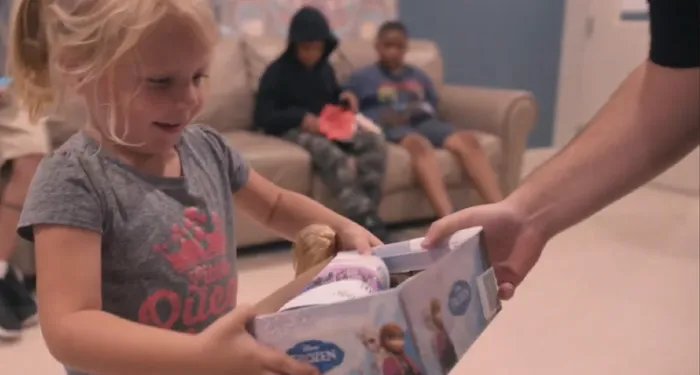
So Gotta Have Sole is a nonprofit that provides youth in homeless shelters with
brand-new shoes.
And you might ask, why shoes of all things? Well, homeless children are often
experiencing serious poverty or have had to leave a bad situation in a hurry.
They will walk into a shelter wearing shoes that are worn to holes or don't fit
or aren't appropriate for the elements.
And it's one of the ways that kids can really stick out in a crowd and make
them feel embarrassed or inferior.
And this was something that Gotta Have Sole
Founder Nick Lowinger noticed really early on while he was accompanying his
mother who worked in shelters as an art therapist.
He was only five years old when he started doing this, and it first struck him
as an idea.
So here, Nick explains.
NICK LOWINGER: My mom is an art therapist, and
was doing a lot of work in the shelter system when I was a kid.
And so when I was five, I had just gotten a brand new pair of light up sneakers
as many five-year-olds do.
I was very excited to stomp around, and show them off to other kids.
And before we went into the shelter, my mom said that I shouldn't do any of
that, because a lot of the kids might not have shoes at all, let alone new
shoes, or shoes that fit.
And so obviously at five that really burst my
bubble. I had only ever known shoes to be a given.
And so when I went in, and I was meeting the kids, and becoming friends with
them, I was looking at them, and I was also looking down at their feet.
And I saw a lot of kids who were barefoot, or wearing shoes that were really
tattered, or held together with duct tape, shoes that didn't fit.
And then I had just never seen that before, and it really struck me. It
bothered me.
I knew I wanted to do something, but I was five, so there wasn't a ton that I
thought I could do at that time.
But when I went home, I went through my closet to see what shoes I could
donate, or clothing that didn't fit anymore.
And I realized quickly when I made the donation of those things to the shelter
that I could only help the few kids who could fit into my size.
And so that was really
when the seed was planted for what eventually became Gotta Have Sole.
MEGAN HANLON: And this passion to help never
left him, and the idea returned to him when he was about 12 and he was looking
for a Bar Mitzvah project idea.
He explained to his parents that, "I remember seeing this and I want to
help."
And his parents said, "You know, that sounds a lot like a charity or a
501(c)(3)."
And of course, as a child, he had never heard of this, but his parents helped
him set it up and he received the official letter on the first day of seventh
grade, which is really, really young for somebody to start displaying such
amazing generosity and helpfulness.
NICK LOWINGER: Well, I think the beauty of
childhood is kind of that naivety, if you will, is so beautiful where you
haven't had the influence of the world, and stigmas that have built up.
And so I just saw other kids, they were new potential friends to me, and I
became friends with some of them back then.
And I didn't really pay much attention to the financial background, or the
haves, and have-nots.
But to me, shoes were always a basic need, and it was something that I had
always assumed everyone would have.
So, when I saw that, I just saw a bunch of fellow peers of mine who couldn't do
the things that I could do.
And to me the easy solution was get them the shoes they need so they can play,
and be kids.
I think it was really that simple idea, and most importantly, that lack of
stigma.
MEGAN HANLON: So he stuck with it all this time, but he wasn't really sure that that was going to be his path in life.
He went to college to explore his options and considered a career in finance or
business, like a lot of his peers did.
But he graduated in 2020, which was the worst of the pandemic when a lot of
people were suffering during pandemic shutdowns.
He saw homelessness skyrocket during that year and he kept thinking that nobody
was really addressing this.
So he decided that he had caught the bug of giving back and he was going to go
back to it.
Since its founding, Gotta Have Sole has provided
shoes to more than 125,000 kids in more than 220 shelters.
But what really makes the program special is that each pair of new shoes has a
personalized note that's put into it and that really speaks to each one of the
kids.
And here, Nick explains.
NICK LOWINGER: So, we have cards that people decorate that it's a little
stencil of almost like a Converse kind of sneaker with our logo, and people
draw on them, decorate them, write beautiful personalized message of hope with
the kid's name.
So, when they're receiving the shoes, it's a really special moment, and a gift
that, I mean, it resonates so much with them.
But a lot of times kids,
we want to make sure they get the shoes that fit.
So, if they try a shoe on, it's too small, too big, whatever, we will swap it
out with something in our stock that will fit them.
Oftentimes they don't want to give the shoes back because they think they have
to give the card back also.
So, I mean, that's a really beautiful thing that it shows them someone in the
community, and someone in the world cares, and took the time out of their day to
do something special for them.
MEGAN HANLON: For children they serve in the
shelters, and these shelters are primarily located in the Northeast, this is
one of those things that can help them feel confident and comfortable and
important during an otherwise traumatic time.
Nick told me a story of just one of these children who was deeply impacted by
getting new shoes after leaving a domestic violence situation.
NICK LOWINGER: There was
a family that the mother, and son had to flee a domestic violence situation,
and immediately get into an emergency shelter that night.
The dad left after, thankfully what was the last beating that his mother had to
endure, and they just grabbed what they could, and ran out of the house, and
made their way to a shelter.
And he didn't really pay attention to what he grabbed. What he did end up
grabbing was his mother's fur-lined boots.
And so that was what he had. That was his only pair of shoes.
And so you can imagine being a teenage boy going to school in women's fur-lined
boots, he was getting bullied.
He was very unhappy, obviously with all of what was going on, that's enough of
an emotional toll, and on top of what he was now going through with the
footwear situation.
So, we were able to get
sneakers immediately to them so that they didn't have to continue living with
that stress, and from what the shelter workers told us, just there was a real
visible change, and almost like an excitement to go to school because now he
wouldn't face the ridicule.
Obviously, there was a lot to process individually from the situation they were
in, but to alleviate that big stressor was huge, and really set him up to
succeed in the situation that they were in.
I mean, that really hit home for me, just as an only child who's very close
with both my parents, and thankfully not in a situation like that, I can only
imagine your head goes, I'm getting my mom out of here.
We're going to get safe.
The last thing you're thinking about is taking care of yourself.
And so it's nice in a situation like that where oftentimes a lot of these kids
don't have a constant, we can be that constant.
MEGAN HANLON: I loved the story behind Gotta
Have Sole and the fact that Nick is continuing to devote his life to helping
others through this organization.
It's just a really fantastic way to help kids who are hurting in so many ways.
And I am thrilled that this grant will allow Gotta Have Sole to help even more.
FRANK BLAKE: Megan, the amazing thing to me is
we featured other Crazy Good Turns that children have started, but I can't
remember too many where you have a through line from the age of five through to
college.
I mean, quite extraordinary.
MEGAN HANLON: It is. It really speaks to his
dedication and how much he believes in this program and the results that he can
see, that he knows he's doing a good thing and he wants to continue.
And I love that.
FRANK BLAKE: Truly, truly Inspired Generosity.
Thank you. Thank you.
LESLIE NUNN: Can I make one little interjection?
FRANK BLAKE: Please.
MEGAN HANLON: Sure.
LESLIE NUNN: What I loved about it too,
especially because you know when you get shoes, if you don't have socks, you'll
get blisters. So I love the fact that he gives socks with each pair of shoes
and a personal note. I thought that was the cherry on the ice cream there.
FRANK BLAKE: Well said. Well said.
BRIAN SABIN: Absolutely.
FRANK BLAKE: Well, now, so Leslie, you're going
to discuss Bridge of Hearts. So you want to tell our listeners about Bridge of
Hearts?
LESLIE NUNN: Yes.
Bridge of Hearts really touched my heart because I have teachers in my family,
several, and they often in conversations will say, "You know, we know. We
know when those children come to school, we know which ones have a little bit
more of a challenge or there's things going on at home," and those are the
teachers that aren't just teachers, they're dialed in and it's a calling for
them.
And those children are important and they put a little extra into those kids
and they identify needs and they meet those needs where they see them.
And this organization, Bridge of Hearts, is out
of North Carolina and it's founded by a group of retired teachers, and they
retired and they had few little weeks of fun, and then they were like,
"Well, that was fun, but what about what we're called to do?"
So they went ahead and they put their heads together, and who we have
interviewed is Linda Morris.
LINDA MORRIS: I think if you've spent 25, 30, or 40 years working with
children, you must love children. And we did and we do.
And we got to thinking, "Okay, so now we're not in the school building,
but that doesn't mean that we can't help children."
And one of the things that we had seen when we were all working together was that when birthdays came around, some of our children who came from rather well off families, the mom would come in with this huge tray of cupcakes for everybody, and they were all beautifully decorated.
And you knew there was a party coming after that for that child.
But then we had children who didn't have that ability to bring things in. And
you knew that in some cases there wouldn't be a birthday party.
And one of the things that we know as an educator is how very important birthdays are to a child.
It's a rite of passage. And if you think about it, one of the first things we
ask children when we meet them is, "Oh, how old are you?"
And they'll say, "Oh, I'm three," or, "I'm four and a
half."
So it's an important part of their development. And we thought, "Well, can
we do something about that?"
So because teachers are
optimistic and sometimes naive, we went, "Sure, we can do that."
And then we quickly realized we had no money and we had no space and we had no
volunteers, but that didn't stop us.
So we jumped in and started making birthday bags.
LESLIE NUNN: Birthdays are really special to kids, and so they came up with doing a little bag and they would send it home with the parents with the cake mix, presents, and they let the parents do the cake and give the gifts.
It didn't highlight that their children were
going to do without.
It gave the parents the opportunity to be the hero.
And they don't put their names on anything, the organization name. They don't
put a big sticker, "This is from Bridge of Hearts."
They do it through the schools and let the schools give it to the families and
so the families are also feeling special too. Like, "Hey, I didn't let my
child down. I did it for them."
FRANK BLAKE: And probably for the child, less
pulling than, saying, "This child is treated by third parties."
LESLIE NUNN: Yeah, exactly.
FRANK BLAKE: It makes the child the same as
everyone else in a way.
LESLIE NUNN: Exactly. And it makes them, every... It's just a win-win. It really, really is.
I just, again, I just think it's so special and they've gone on to expand.
After they started doing that, they looked around and they said, "Hey,
what else can we do?"
And they realized they needed snacks, that oftentimes things that most kids
take for granted, they didn't have a little snack, so they started doing snack
bags.
They started doing hygiene kits because that's one thing too that will separate
those kids that need a little boost is just hygiene and things like that.
And they're always looking to help in different
ways and it's such a boots-on-the-ground, grassroots effort.
And like so many of these things we highlight, it's dependent upon volunteers
and just the goodness in people's hearts and meeting a need where they see it.
And I just think that's awesome.
FRANK BLAKE: It's also... I enjoyed a story that she told about one of the volunteers running into a bakery and somebody recognizing that.
LINDA MORRIS: And one of
the little bakery workers realized that there was a real problem, and she came
up.
And so she was talking with Chloe, the leader, and somehow or another it came
up that the birthday was for me and that I ran Bridge of Hearts and she went,
"Bridge of Hearts?"
And she went, "Yeah."
She said, "I moved to this town two years ago and I was really down and
out, and you all provided a birthday party for my child, and I cannot tell you
how thankful I am that you enabled to do that."
She said, "Now I'm okay. I'm back on my feet." But she said,
"You stepped in and fill that need for me, and I am so appreciative."
FRANK BLAKE: It is a great story, and I loved, Leslie, the way you introduced
it in terms of how teachers connect with their students and just the passion to
help their students.
And when I think about, over the time period that we've been doing Crazy Good
Turns, the number of people who when asked, "Who's done a Crazy Good Turn
for you," talk about their teacher, that's the back story of this entire
award is what teachers do for our students.
LESLIE NUNN: Exactly. It's a calling, not a job.
FRANK BLAKE: Yep. Great.
BRIAN SABIN: Yeah. And what a remarkable
difference they make.
FRANK BLAKE: Yeah, brilliant. All right. So
Brian, you're going to be talking to us about Golden Strings.
BRIAN SABIN: I am. It is an honor and a pleasure
to talk to you about Golden String. They're based nearby me. They are in
Youngstown, Ohio.
As listeners may know, I'm over in Cleveland.
And Golden String came to our attention through a friend.
His mother was a longtime volunteer for this organization. She spent her time
serving one of their many organizations.
Golden String is actually one of several, but we're going to call it Golden
String to encompass everything just for the sake of simplicity here.
And what they do is provide a number of services
to people with disabilities, and these disabilities can range from physical
disabilities to mental disabilities and difficulties.
And all of this started with their founder, Jimmy Sutman, who, at a very young
age, had a friend who had some needs. And here's Jimmy describing how that came
about.
JAMES SUTMAN: I wasn't brought up with a lot of folks with disabilities or
anything like that.
There was just a need, and I was 25-years-old and I didn't have a lot of
responsibility, and this family needed somebody to watch Joe.
BRIAN SABIN: So Joe here is Joe Gallagher.
He was a 50-something-year-old man with Down syndrome, and at the time Jimmy
was working with him, he was working through the State of Ohio providing
programming for adults with developmental disabilities.
And in fact, at that job, Joe was Jimmy's first client and they formed a bond.
JAMES SUTMAN: I had known his family and Joe was
spending two weeks living with one brother and two weeks living with another
brother in his early 50s and at one point, he just rebelled.
He wasn't choosing one brother over the other, he just didn't want to move
every two weeks.
And the family was distraught and I said, "He can move in with me. I got
this crazy idea."
I went back to Youngstown State University, took a couple of classes and was
licensed through the State of Ohio then to be a residential provider.
BRIAN SABIN: So what started with this
one-to-one relationship, this one-to-one friendship has grown into a
residential care program that now serves more than 80 adults with disabilities.
They have their own place now and they no longer operate out of Jimmy's home,
but the experiences that Jimmy had with Joe still influence many of their
activities and it all started with baseball.
JAMES SUTMAN: Joe was a huge Cleveland Indian
fan - called the Indians at that time.
And every night he used to even pray for the Cleveland Indians starting lineup.
He would just go through those starting lineup and pray for those people, not
the subs.
And then he loved the Indians, so we would watch them on the radio, mostly Tom
Hamilton on the radio.
But we both were poor and just we heard an ad that the Cleveland Indians
Charitable Foundation will give free tickets to people, but you must be a
501(c)(3), so strangely enough, that's simply how we started Golden String, Inc
was to get Joe Gallagher Cleveland Indians tickets.
Now it is really expanded to driving people to the Cleveland Clinic, a lot of
transportation.
But we're building GabbaCamp, a camp for adults with disabilities.
We already have a little restaurant called Joe Gallagher's Lunch Bucket, where
we have 35 adults with disabilities that serve breakfast and lunch to our area,
governmental agencies like the Board of Elections, Department of Jobs and
Family Services, those types of groups keep us going.
BRIAN SABIN: So today, Golden String and Purple
Cat, one of its sister organizations, make all of these activities possible and
more.
They have a farm where the disabled can come and help care for animals and a
camp where people can come and spend a week relaxing, enjoying nature and
learning some more life skills.
The camp, the farm, and all these great activities have led the organization to
get more attention both regionally and from out of state.
JAMES SUTMAN: I'm just coming off of a meeting of an
individual from Naples, Florida, his family bought a house here in Youngstown
simply because they want their son, who is squarely on the autism spectrum, to
have Golden String activities and get to camp-
FRANK BLAKE: Wow.
JAMES SUTMAN: ... and all of this as they're
aging.
Next week, on Monday, I have another person from Florida coming in.
There's no coincidence with Florida because it's one of the states that has
very little social services for adults with developmental disabilities.
They're catching up, I pay attention to that. They're catching up, but they're
way behind.
So states like Ohio, and New York, and Pennsylvania are getting an influx of
folks with disabilities because their families realize, "We want to take
our loved one to a place where there's lots of services."
BRIAN SABIN: So Frank, you spoke with Jimmy?
FRANK BLAKE: I did. Amazing, amazing guy.
BRIAN SABIN: Absolutely. And during your
interview, you asked a very appropriate question of him.
With so many organizations providing so many services to so many different
people, how does he find the energy to get all this done?
And I thought his response was great and I wanted to share that here.
JAMES SUTMAN: I'm one of those people that I love to be a problem solver.
When an individual says to me, "My dream is to go to Universal Studios in Orlando," well, that's easy. We can make that happen.
So I enjoy doing those types of things.
It's people. I'm not selling anything. I'm not
trying to buy anything. These are people that I'm dealing with and their lives.
I get out of bed with a spring in my step because I know I got to do X, Y, and
Z.
And because next to our camp, we have a farm, those animals need fed.
Even taken it further, I was like, "I got to get up, I can't sleep in.
There's a chicken, I've got to go check this out."
I don't know, I don't have a definitive, or I can't put it in a couple
sentences, but I love life and I love people.
FRANK BLAKE: Yeah, I just think it's a great example. This is amazing guy and
what he's done is incredible. I will...
Also, I have an interesting anecdote at the end of this because after talking
with Jimmy, we exchanged emails on a number of things, and in one of them, he
said he had been late to respond because the Home Depot volunteer team had been
there working on his farm.
And I thought, "Wow, that's the perfect exclamation point."
Having worked years at Depot, I'm so proud of Depot's giving back to the
community and doing Inspired Generosity, and so impressed with what Jimmy is
doing and what he has succeeded to build.
I mean, it's just an amazing, amazing story.
So thank you, Brian. Thank you, Jimmy, Inspired
Generosity Awards.
I will also close this out by saying that as the four of us reviewed all these
submissions, not surprisingly, we go, "Gosh, there are others that we need
to recognize."
So we decided to add five organizations to give
$2,000 to because these are great.
Every organization's great, we'd give money away to every one of them, but
these five we wanted to also highlight.
Some of them are particular, frankly, because of their long-term relationship
with Crazy Good Turns.
So we want to give $2,000 to Uplifting Athletes, which was recommended to us by Shannon Cassidy, who, as you'll remember, was one of our guests a while back and has a great generous heart and Uplifting Athletes is a great organization.
We are giving $2,000 to the Breast Cancer
Prevention Partners, and this one is much more personal to me because the
suggestion came in from Bill Lenahan and Bill Lenahan is a colleague of mine
who I would put as one of the smartest people I've ever worked with and also
one of the most philanthropically inclined.
And so when he said, "Award money to this organization," I say,
"of course we're going to do that."
So $2,000 to the Breast Cancer Prevention Partners.
$2,000 to the New Hanover Community County
Community Justice Center.
Also, this one has a personal relationship with me because it was suggested by
Mike Rossi, who is a Home Depot associate who I worked with years and years ago
in Wilmington, North Carolina.
Just a phenomenal person and we've recognized him and his philanthropic
interests in the past in Crazy Good Turns and I'd like to do that again.
Also, $2,000 to the Art Center Theatre in Plano,
Texas.
I referenced that earlier in the introduction. We got... Gosh, Brian, how many
submissions do we get on the Plano, Texas? It was a lot, right?
BRIAN SABIN: We heard from a lot of people-
FRANK BLAKE: A lot.
BRIAN SABIN: ... about Art Center in Plano.
It's a great group that does basically theater for parents of neurodiverse, for
neurodiverse individuals, so really, really powerful non-profit.
And then finally, Spartansburg Events, which...
BRIAN SABIN: Spartansburg, Pennsylvania.
FRANK BLAKE: Spartansburg, Pennsylvania, and
their Inspired Generosity of just a community helping each other.
I mean, it's just a great heartwarming story of a community pulling together to
help each other. Small town.
BRIAN SABIN: Small.
FRANK BLAKE: 300 residents, but everywhere... I mean, you just realize the great power of caring for each other and being generous, and that's what this program is all about.
So congratulations to every one of our winners.
Congratulations to you, those of our listeners who submitted nominees.
I hope that this keeps growing over time.
If we have the same growth year over year over the next few years, we're going
to turn this into one of the most interesting award presentations in the
country, and it would be great to get thousands of recommendations for Inspired
Generosity.
So thank you, Brian. Thank you, Megan. Thank
you, Leslie.
And thank you to all of our listeners, and congratulations to all of our
winners.
From Frank Blake
My Sincere Thanks
Your support has helped take our little idea to celebrate generosity and good deeds, and turn it into one of the most listened-to podcasts available.
Thank you for being part of a community that celebrates people who do good things for others.
Your giving of your time to listen to these interviews, and acknowledging those good deeds, is a crazy good turn of its own.
Please help us continue to grow by subscribing on your preferred podcast platform.
And please, help us spread the word by sharing our show and website with friends.